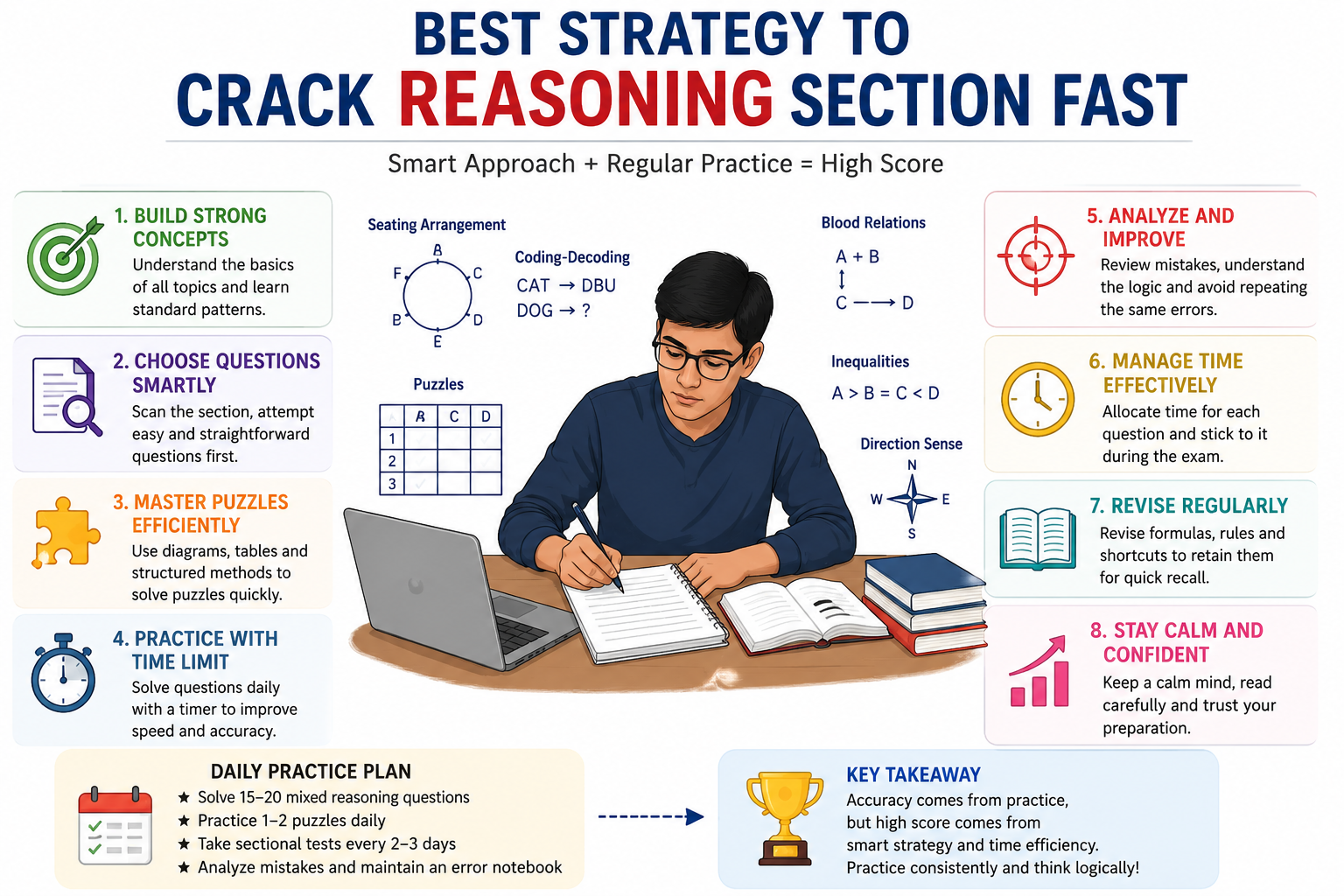
Understand the Nature of Reasoning Questions
Reasoning questions test how quickly you interpret information and apply logic. The section typically includes:
- Seating arrangement
- Puzzles and blood relations
- Coding-decoding
- Syllogism and inequalities
- Direction and distance
Key insight:
Speed improves when patterns become familiar, not when questions are rushed.
Build Strong Conceptual Clarity First
Skipping fundamentals is the most common mistake.
Focus areas:
- Learn standard patterns for puzzles
- Understand symbol-based logic (>, <, = in inequalities)
- Practice diagram-based representation
Why it matters:
Without conceptual clarity, solving time increases and accuracy drops under pressure.
Use the Right Question Selection Strategy
Not every question deserves equal time.
Execution approach:
- Scan the section in the first 1–2 minutes
- Attempt direct and short questions first
- Skip lengthy puzzles initially
Result:
Higher attempts with controlled time usage.
Master Puzzle-Solving Techniques
Puzzles carry significant weight but consume time if approached incorrectly.
Efficient method:
- Start with information-rich clues
- Create structured diagrams or tables
- Avoid re-reading the entire question repeatedly
Pro tip:
Practice one puzzle type repeatedly until pattern recognition becomes automatic.
Improve Speed with Timed Practice
Speed is a trained skill, not an inherent ability.
How to train:
- Set strict time limits for each question
- Practice sectional quizzes daily
- Gradually reduce solving time
Outcome:
Faster decision-making without guesswork.
Strengthen Accuracy Through Error Analysis
Speed without accuracy reduces overall score due to negative marking.
Correction process:
- Identify why the mistake occurred
- Re-solve the question without time pressure
- Note recurring error patterns
Impact:
Prevents repetition of the same logical mistakes.
Develop a Time Allocation Framework
Unstructured time usage leads to incomplete sections.
Suggested allocation (for a 20–25 min section):
- 2–3 min: Scan and select questions
- 10–12 min: Easy and moderate questions
- Remaining time: Selected puzzles
Goal:
Maximize attempts while maintaining accuracy.
Avoid Common Mistakes
- Spending too much time on a single puzzle
- Ignoring easy scoring questions
- Practicing without time constraints
- Not revising previously solved patterns
- Guessing answers without logical validation
Each of these slows down performance and reduces efficiency.
Daily Practice Plan for Reasoning Speed
- Solve 15–20 mixed questions daily
- Practice 1–2 puzzles with full focus
- Take a sectional mock test every 2–3 days
- Review all incorrect answers
Consistency in this routine builds both speed and confidence.
Final Insight
Cracking the reasoning section fast is not about rushing—it is about minimizing unnecessary thinking time. When concepts are clear, patterns are familiar, and strategy is defined, speed becomes a natural outcome.
The objective is simple: solve more questions correctly in less time. Achieving this requires disciplined practice, smart selection, and continuous refinement.