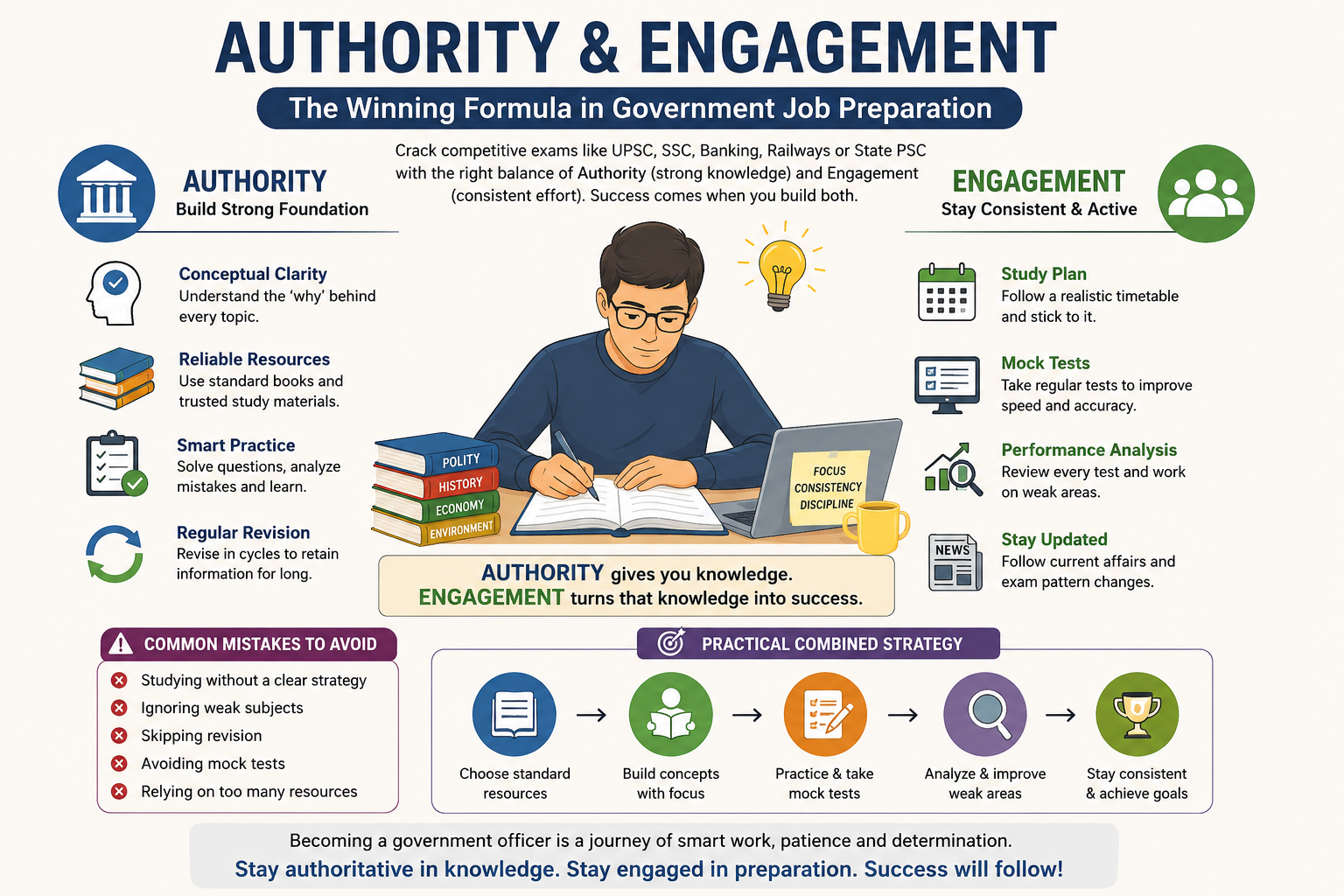
Understanding Authority in Government Exam Preparation
Authority in this context refers to command over subjects, conceptual clarity, and the ability to apply knowledge accurately under exam conditions.
What Builds Authority
- Conceptual Depth: Knowing the reasoning behind answers, not just memorizing them
- Standard Resources: Using reliable books and verified study materials
- Revision Cycles: Repeated exposure to the same content strengthens retention
- Practice with Analysis: Solving questions and understanding mistakes
Why Authority Matters
Exams conducted by bodies like Reserve Bank of India or State Bank of India often test analytical ability rather than direct recall. Without authority, candidates struggle with unfamiliar question patterns.
Understanding Engagement in Preparation
Engagement reflects how actively a student interacts with the study process. It is not about hours spent, but about focus, consistency, and adaptability.
Indicators of Strong Engagement
- Regular participation in mock tests
- Reviewing performance after each test
- Staying updated with current affairs
- Maintaining a structured study routine
Why Engagement Matters
Even candidates with strong knowledge fail if they lack consistency. Engagement ensures that preparation continues without long breaks or loss of momentum.
Authority vs Engagement: Why Both Are Required
Aspirants often lean heavily toward one side:
- Strong knowledge but irregular practice leads to poor time management
- Consistent effort without conceptual clarity leads to repeated mistakes
A balanced approach ensures both accuracy and speed, which are critical in competitive exams.
How to Build Authority in Key Subjects
Quantitative Aptitude
Focus on understanding formulas and their applications. Avoid shortcut dependency in the early stages.
Reasoning Ability
Develop logical thinking through puzzles and structured problem-solving rather than guesswork.
General Awareness
Follow credible sources for current affairs and revise static GK regularly.
English Language
Work on comprehension, vocabulary, and grammar through consistent reading and practice.
How to Improve Engagement During Preparation
Create a Realistic Study Plan
Allocate time based on subject difficulty and personal strengths. Avoid overloading the schedule.
Take Mock Tests Frequently
Simulate real exam conditions. Platforms like MockPulse can help track performance and identify weak areas.
Analyze Every Attempt
Identify error patterns instead of just checking scores.
Stay Connected to the Exam Pattern
Regularly review previous year papers to understand trends and difficulty levels.
Common Mistakes Aspirants Make
- Studying without a clear strategy
- Ignoring weaker subjects
- Skipping revision
- Avoiding mock tests due to fear of low scores
- Relying on too many resources instead of mastering a few
A Practical Combined Strategy
Start by selecting standard resources for each subject. Build conceptual clarity through focused study sessions. Introduce mock tests early in the preparation phase and gradually increase frequency. After each test, analyze mistakes and revise accordingly. Maintain consistency rather than chasing long study hours.
This approach strengthens authority while keeping engagement intact.
Conclusion
Government job preparation is not just about hard work—it requires structured effort backed by clarity and consistency. Authority gives you the ability to solve problems correctly. Engagement ensures you keep improving over time.
Aspirants who develop both are better equipped to handle exam pressure, adapt to changing patterns, and achieve long-term success in competitive exams.