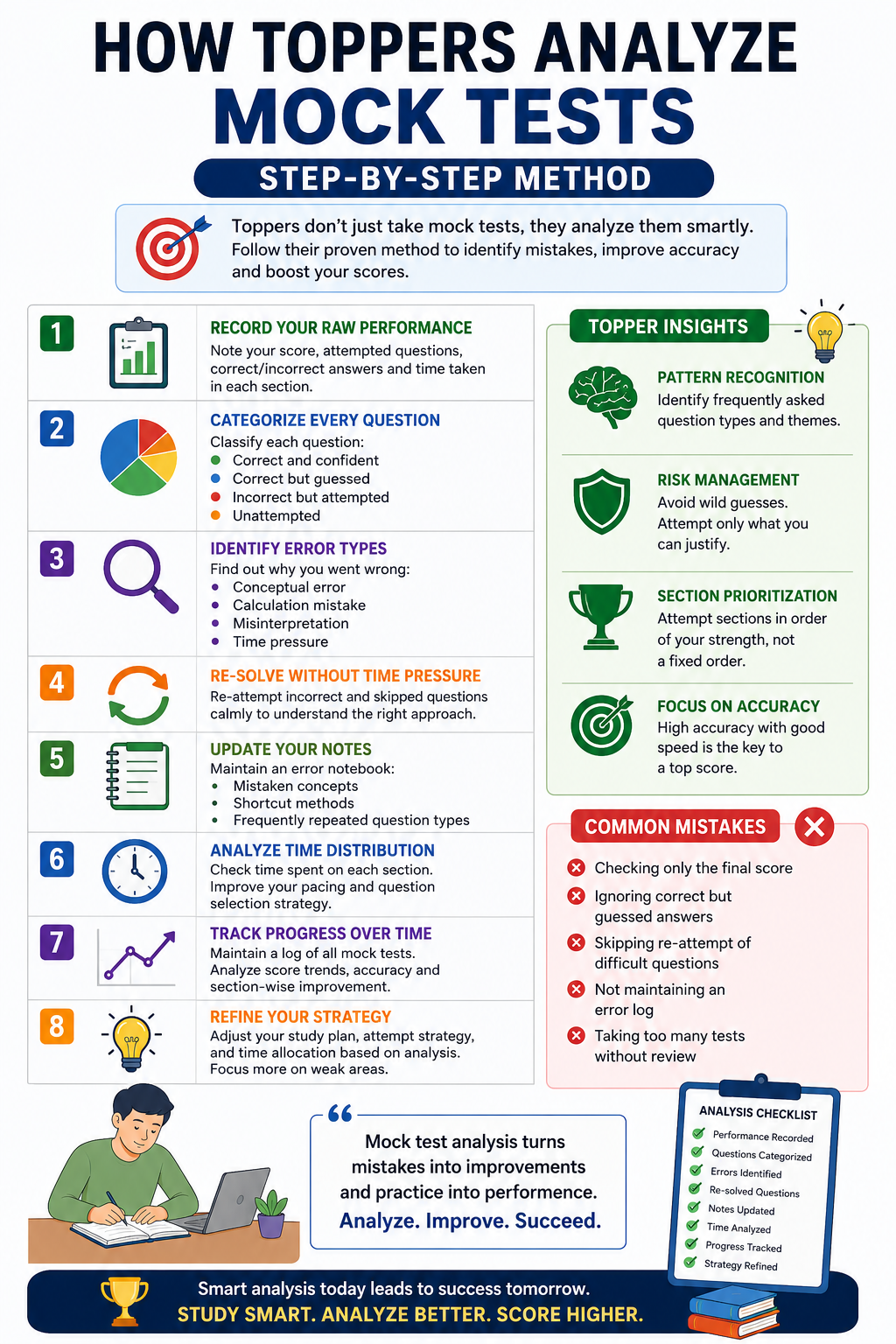
Why Mock Test Analysis Matters
Attempting tests without reviewing them leads to repeated mistakes. Analysis converts raw scores into actionable improvements.
What Proper Analysis Achieves
- Identifies weak concepts
- Improves accuracy and speed
- Reduces negative marking
- Builds exam temperament
Step-by-Step Method Toppers Use
Step 1: Record Your Raw Performance
Immediately after completing the test, note down key metrics:
- Total score
- Attempted questions
- Correct vs incorrect ratio
- Time spent per section
This creates a baseline for improvement.
Step 2: Categorize Every Question
Toppers do not review randomly. They classify each question into specific categories:
- Correct and confident – Strong area
- Correct but guessed – Needs reinforcement
- Incorrect but attempted – Conceptual gap
- Unattempted – Time or knowledge issue
This classification reveals patterns in performance.
Step 3: Identify Error Types
Not all mistakes are equal. Break them into precise categories:
- Conceptual errors
- Calculation mistakes
- Misinterpretation of questions
- Time pressure errors
Understanding the nature of mistakes prevents repetition.
Step 4: Re-solve Without Time Pressure
Go back to incorrect and skipped questions and solve them again calmly. This step helps isolate whether the issue was lack of knowledge or exam pressure.
Step 5: Update Your Notes
Toppers maintain a dedicated error notebook. Include:
- Mistaken concepts
- Shortcut methods
- Frequently repeated question types
This becomes a personalized revision resource.
Step 6: Analyze Time Distribution
Check how time was allocated across sections:
- Did one section consume excessive time?
- Were easy questions skipped due to poor sequencing?
Adjust your attempt strategy based on this insight.
Step 7: Track Progress Over Time
One test does not define performance. Maintain a log of multiple mock tests to track:
- Score trends
- Accuracy improvement
- Section-wise growth
Consistent tracking highlights real progress.
Step 8: Refine Your Strategy
Based on analysis, modify your approach:
- Change question selection order
- Adjust time allocation
- Strengthen weak topics
Platforms like MockPulse can assist in tracking analytics efficiently.
Common Mistakes During Mock Analysis
- Checking only the final score
- Ignoring correct but guessed answers
- Skipping re-attempt of difficult questions
- Not maintaining an error log
- Taking too many tests without review
Advanced Insights Used by Toppers
Pattern Recognition
Repeated exposure helps identify frequently asked question types.
Risk Management
Toppers avoid high-risk guesses that increase negative marking.
Section Prioritization
They attempt sections based on strength rather than fixed order.
Practical Example of Analysis Flow
- Attempt mock test under exam conditions
- Record performance metrics
- Categorize questions
- Identify error types
- Re-solve difficult questions
- Update notes
- Adjust strategy for next test
This structured cycle ensures continuous improvement.
Conclusion
Mock tests are powerful only when analyzed correctly. Toppers treat every test as feedback, not just evaluation. Their improvement comes from disciplined review, not just repeated attempts.
If you adopt this step-by-step method, your preparation will become more focused, efficient, and result-driven—bringing you closer to success in competitive exams.