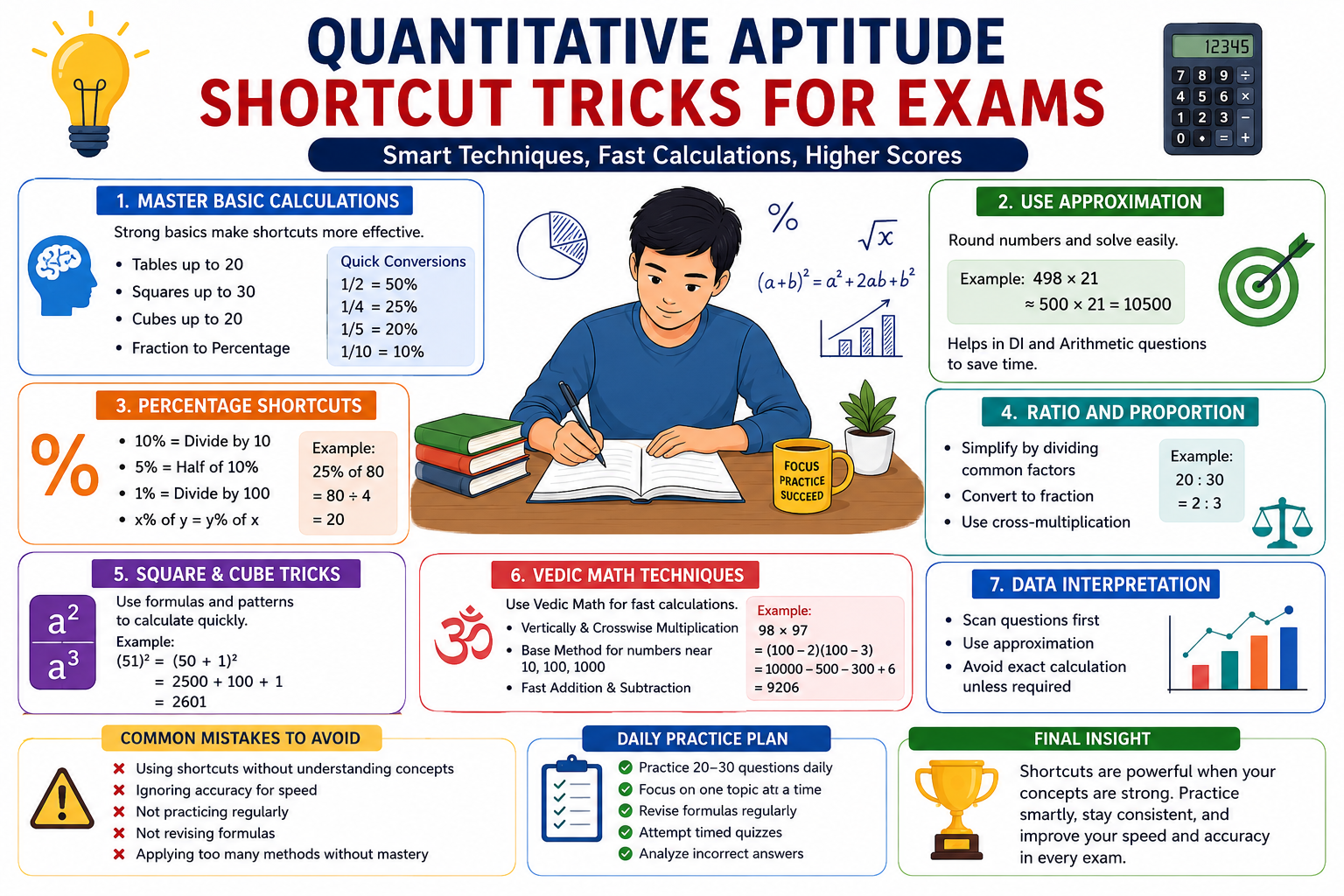
Competitive exams are time-bound. Every second saved on one question increases the chance of attempting another.
Core advantages:
- Reduces calculation time
- Improves overall speed
- Enhances accuracy when applied correctly
- Increases total attempts
Master Basic Calculations First
Shortcut tricks are effective only when fundamentals are strong.
Focus areas:
- Tables up to 20
- Squares up to 30
- Cubes up to 20
- Fraction-to-percentage conversions
Example conversions:
- 1/2 = 50%
- 1/4 = 25%
- 1/5 = 20%
Impact:
Strong basics reduce dependency on rough work and speed up mental calculations.
Use Approximation Techniques
Approximation helps eliminate options quickly in multiple-choice questions.
Method:
- Round numbers to the nearest value
- Solve simplified expressions
- Match with the closest option
Example:
- 498 × 21 ≈ 500 × 21 = 10500
Use case:
Effective in DI (Data Interpretation) and arithmetic questions.
Apply Percentage Shortcuts
Percentage-based questions appear frequently in exams.
Quick tricks:
- x% of y = y% of x
- 10% = divide by 10
- 5% = half of 10%
- 1% = divide by 100
Example:
- 25% of 80 = 80 ÷ 4 = 20
Result:
Faster calculations without lengthy steps.
Simplify Ratio and Proportion Problems
Complex ratios can often be reduced quickly.
Technique:
- Divide terms by common factors
- Convert ratios into fractions
- Use cross-multiplication efficiently
Example:
- 20:30 = 2:3
Benefit:
Simplifies calculations and reduces errors.
Learn Square and Cube Tricks
Direct formulas reduce calculation steps.
Square trick example:
- (a + b)² = a² + 2ab + b²
Application:
- 51² = (50 + 1)² = 2500 + 100 + 1 = 2601
Outcome:
Speeds up algebraic and arithmetic calculations.
Use Vedic Math Techniques
Vedic math provides structured shortcuts for faster computation.
Popular methods:
- Vertically and crosswise multiplication
- Base method for numbers near 10, 100, 1000
- Rapid addition and subtraction
Advantage:
Reduces dependency on written calculations.
Practice Data Interpretation Smartly
DI questions require both calculation and interpretation.
Efficient approach:
- Scan questions before analyzing data
- Use approximation wherever possible
- Avoid exact calculation unless necessary
Goal:
Save time while maintaining accuracy.
Avoid Common Mistakes
- Applying shortcuts without understanding concepts
- Ignoring accuracy in pursuit of speed
- Skipping regular practice
- Using too many techniques without mastery
- Not revising basic formulas
Each mistake reduces effectiveness of shortcut methods.
Daily Practice Strategy
- Practice 20–30 questions daily
- Focus on one topic at a time
- Revise formulas regularly
- Attempt timed quizzes
- Analyze incorrect answers
Consistency ensures that shortcuts become automatic.
Final Insight
Shortcut tricks in quantitative aptitude are tools, not replacements for understanding. When used correctly, they transform complex calculations into manageable steps and significantly improve exam performance.
The objective is not to memorize tricks blindly, but to apply the right method at the right time with confidence and precision.